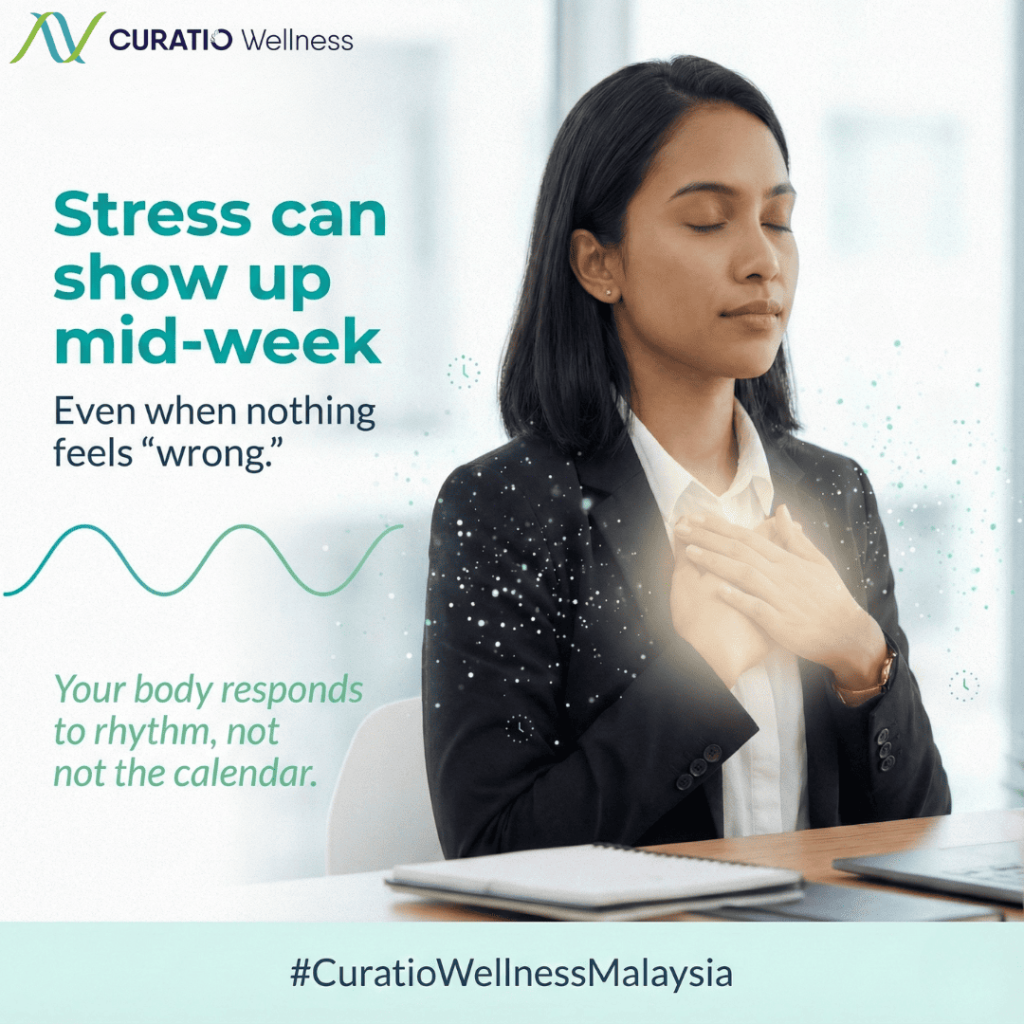
If you’ve ever felt a sudden wave of worry, heaviness, or brain fog in the middle of a workweek, you’re not imagining it. There is a biological reason this can happen.
Your body runs on ultradian rhythms, natural 90-minute energy cycles that alternate between focus and recovery. When you push through the natural mid-afternoon dip, often around 3 PM, without pausing, the brain compensates by releasing extra cortisol to maintain alertness.
Occasional cortisol bursts are normal. But repeating this pattern day after day can leave the body feeling tense, inflamed, and unusually drained by evening.
A simple mid-cycle reset can help: step away from your screen, gently stretch the upper back, or take 10 slow breaths. These small signals tell the nervous system that it is safe to downshift, reducing the cortisol surge.
If you’re exploring how daily rhythms influence stress and metabolism, Curatio Wellness shares calm, evidence-based explanations you can follow at your own pace.
#CuratioWellness #StressScience #MalaysiaWellness #LifestyleMedicine #MindBodyConnection
/* widget: Post List */ #uc_post_list_elementor_0c306bc{ display:grid; } #uc_post_list_elementor_0c306bc .uc_post_list_image div{ background-size:cover; background-position:center; } .uc_post_list .uc_post_list_box{ position: relative; overflow: hidden; display: flex; } #uc_post_list_elementor_0c306bc .uc_post_list_image{ flex-grow:0; flex-shrink:0; overflow: hidden; } #uc_post_list_elementor_0c306bc .uc_post_list_image img{ width:100%; height:100%; display:block; transition:0.3s; position: relative; z-index: 1; } .uc_post_list_title a{ position: relative; z-index: 1; color: #333333; display: block; } .uc_post_list_date{ font-size: 12px; } #uc_post_list_elementor_0c306bc .uc_post_list_content{ display:flex; flex-direction:column; flex:1; } #uc_post_list_elementor_0c306bc .uc_more_btn{ text-align:center; text-decoration:none; transition:0.3s; position: relative; z-index: 1; } #uc_post_list_elementor_0c306bc .button-on-side{ display:flex; align-items:center; } #uc_post_list_elementor_0c306bc .ue-grid-item-category{ display: flex; align-items: center; } .ue-grid-item-category a{ display:inline-block; font-size:10px; text-transform:uppercase; white-space: nowrap; } #uc_post_list_elementor_0c306bc .ue-meta-data{ display:flex; flex-wrap: wrap; line-height:1em; } #uc_post_list_elementor_0c306bc .ue-grid-item-meta-data{ display:inline-flex; align-items:center; } .ue-grid-item-meta-data{ font-size:12px; } #uc_post_list_elementor_0c306bc .ue-grid-item-meta-data-icon{ line-height:1em; } #uc_post_list_elementor_0c306bc .ue-grid-item-meta-data-icon svg{ width:1em; height:1em; } #uc_post_list_elementor_0c306bc .ue-debug-meta{ padding:10px; border:1px solid red; position:relative; line-height:1.5em; font-size:11px; width:100%; } .uc-remote-parent .uc_post_list_box{ cursor:pointer; } #uc_post_list_elementor_0c306bc .ue-post-link-overlay{ display:block; position:absolute; top:0; bottom:0; right:0; left:0; }
Diabetes & Metabolic Health
Reversing Pre-Diabetes & Lifestyle Strategies
Sleep, Stress & Mental Wellness
Stress, Anxiety & Burnout Management
Menopause & Metabolism: What Changes, What Helps

Blood Sugar Control & Insulin Resistance
Diabetes & Metabolic Health
Reversing Pre-Diabetes & Lifestyle Strategies
Diabetes Remission Programme: A Smarter Alternative to Lifelong Medication

Mind-Body Wellness
Weight, Belly Fat & Metabolic Syndrome
When Healing Means Changing How You Listen to Your Body

Genetics & Personalised Health
Health Science & Research
Reversing Pre-Diabetes & Lifestyle Strategies
Beyond Routine Blood Tests: What New Science Reveals About You

Diabetes & Metabolic Health
Nutrition & Diet
Product & Service Spotlights
Diabetes Remission in Malaysia: Can Type 2 Diabetes Be Reversed Naturally?

Diabetes & Metabolic Health
Nutrition & Diet
One Kitchen, Many Needs: How Families Can Eat Healthier Together
No posts found