Why Some People React Differently And Why It Isn’t Your Fault
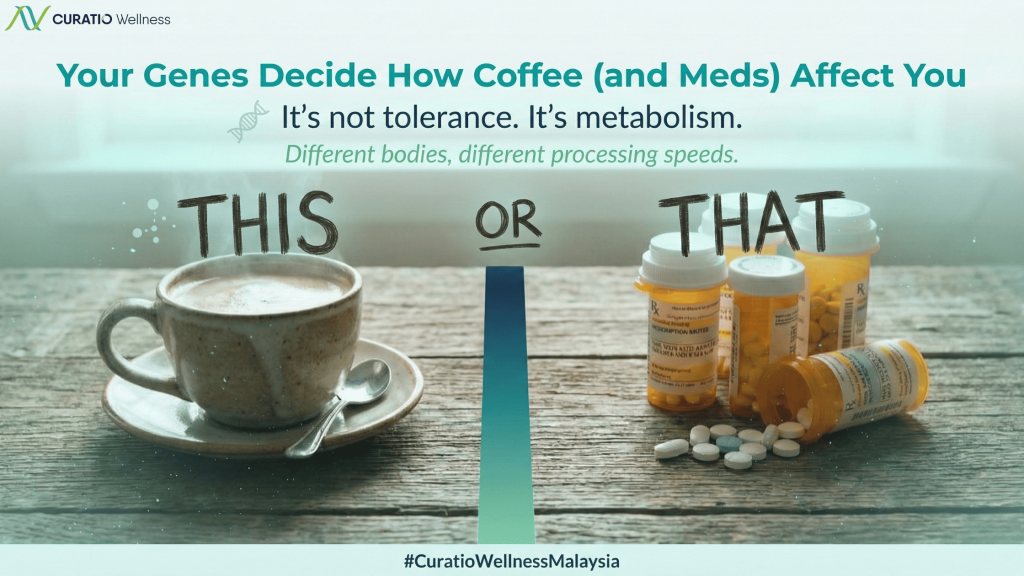
If you have ever wondered why a friend can drink three cups of coffee at night and still fall asleep, while you get palpitations from half a cup, you are not alone. People often assume the difference is about tolerance, lifestyle, or willpower.
But modern science paints a far more reassuring picture. Your response has less to do with habit and more to do with your genes.
This field is called pharmacogenomics, the study of how your genetic makeup influences the way you process caffeine, medications, supplements, and even environmental chemicals. Understanding it removes a layer of self-blame and anxiety. You are not too sensitive or not strong enough. You are simply wired differently, and that wiring has a name.
One of the most well-studied examples is a gene called CYP1A2, which determines how quickly your liver breaks down caffeine and many commonly used medications.
Part 1: The Gene at the Centre — CYP1A2
CYP1A2 is part of a large family of liver enzymes responsible for breaking down substances in the body. These enzymes act like workers on a conveyor belt, deciding how quickly caffeine, certain medications, and dietary compounds are cleared from your system.
Fast metabolizers break down caffeine quickly. Coffee leaves their system faster, providing alertness without lingering stimulation.
Slow metabolizers process caffeine more slowly. Caffeine stays in the bloodstream longer, and even small amounts may trigger jitters, rapid heartbeat, anxiety, or sleep disruption.
Around 40–50% of Asians carry the slow-metabolizer variant. This alone explains why people in the same family, office, or social circle can have vastly different reactions to the same cup of kopi.
The emotional takeaway is simple: your reaction is not overthinking. It is biochemistry.
Part 2: Coffee — Protective for Some, Stressful for Others
Large population studies reveal something surprising. Among fast metabolizers, moderate coffee consumption is associated with a lower risk of heart disease. Among slow metabolizers, higher intake may increase cardiovascular strain.
The difference lies in duration. Fast metabolizers clear caffeine quickly, allowing antioxidants in coffee to act without prolonged stimulation. Slow metabolizers retain caffeine longer, increasing physiological stress if intake is high.
This does not mean coffee is unsafe. It means your personal biology determines your ideal amount.
Calmness comes from knowing you are not weak if coffee makes you anxious, and not unstoppable if coffee barely affects you. You are simply metabolizing it differently.
Part 3: It’s Not Just Coffee — Medication Responses Too
CYP1A2 also plays a role in how the body processes certain antidepressants, anti-inflammatory medicines, asthma medications, hormones, migraine drugs, and common supplements.
People with slower CYP1A2 activity may feel stronger effects from standard doses because compounds remain active longer. Those with faster activity may need more time to feel the intended effect.
This does not mean medication should ever be adjusted independently. It simply explains why conversations with clinicians matter and why two patients on the same treatment may have very different experiences.
Part 4: Why Two People Can Have the Same Prescription but Different Experiences
Pharmacogenomics shows that liver enzyme speed, receptor sensitivity, transport proteins, and genetic variants in cell communication pathways all influence response.
This is not a sign that one body is failing. It is simply two different biological blueprints responding in their own ways.
Part 5: The Emotional Relief of Understanding Your Genetic Patterns
Many people describe a sense of relief when they learn about pharmacogenomics. What once felt like a personal flaw becomes a biological explanation.
Clarity reduces fear. When the mystery fades, the nervous system often settles.
Part 6: Genes Are Influential, Not Deterministic
Lifestyle still matters. Smoking, stress, certain foods, medications, and sleep patterns can temporarily change enzyme activity. Genes guide tendencies, but they do not lock outcomes.
Final Reflection
Your body reacts the way it does because it is designed to protect you, not frustrate you. Pharmacogenomics replaces judgment with understanding and comparison with compassion.
Biology is not competition. It is individuality. And individuality deserves understanding.
#CuratioWellness #Pharmacogenomics #GeneticScience #MetabolicHealth #MalaysiaWellness #CoffeeScience #PersonalisedBiology #RootCauseCare
/* widget: Post List */ #uc_post_list_elementor_0c306bc{ display:grid; } #uc_post_list_elementor_0c306bc .uc_post_list_image div{ background-size:cover; background-position:center; } .uc_post_list .uc_post_list_box{ position: relative; overflow: hidden; display: flex; } #uc_post_list_elementor_0c306bc .uc_post_list_image{ flex-grow:0; flex-shrink:0; overflow: hidden; } #uc_post_list_elementor_0c306bc .uc_post_list_image img{ width:100%; height:100%; display:block; transition:0.3s; position: relative; z-index: 1; } .uc_post_list_title a{ position: relative; z-index: 1; color: #333333; display: block; } .uc_post_list_date{ font-size: 12px; } #uc_post_list_elementor_0c306bc .uc_post_list_content{ display:flex; flex-direction:column; flex:1; } #uc_post_list_elementor_0c306bc .uc_more_btn{ text-align:center; text-decoration:none; transition:0.3s; position: relative; z-index: 1; } #uc_post_list_elementor_0c306bc .button-on-side{ display:flex; align-items:center; } #uc_post_list_elementor_0c306bc .ue-grid-item-category{ display: flex; align-items: center; } .ue-grid-item-category a{ display:inline-block; font-size:10px; text-transform:uppercase; white-space: nowrap; } #uc_post_list_elementor_0c306bc .ue-meta-data{ display:flex; flex-wrap: wrap; line-height:1em; } #uc_post_list_elementor_0c306bc .ue-grid-item-meta-data{ display:inline-flex; align-items:center; } .ue-grid-item-meta-data{ font-size:12px; } #uc_post_list_elementor_0c306bc .ue-grid-item-meta-data-icon{ line-height:1em; } #uc_post_list_elementor_0c306bc .ue-grid-item-meta-data-icon svg{ width:1em; height:1em; } #uc_post_list_elementor_0c306bc .ue-debug-meta{ padding:10px; border:1px solid red; position:relative; line-height:1.5em; font-size:11px; width:100%; } .uc-remote-parent .uc_post_list_box{ cursor:pointer; } #uc_post_list_elementor_0c306bc .ue-post-link-overlay{ display:block; position:absolute; top:0; bottom:0; right:0; left:0; }
Diabetes & Metabolic Health
Reversing Pre-Diabetes & Lifestyle Strategies
Sleep, Stress & Mental Wellness
Stress, Anxiety & Burnout Management
Menopause & Metabolism: What Changes, What Helps

Blood Sugar Control & Insulin Resistance
Diabetes & Metabolic Health
Reversing Pre-Diabetes & Lifestyle Strategies
Diabetes Remission Programme: A Smarter Alternative to Lifelong Medication
Mind-Body Wellness
Weight, Belly Fat & Metabolic Syndrome
When Healing Means Changing How You Listen to Your Body

Genetics & Personalised Health
Health Science & Research
Reversing Pre-Diabetes & Lifestyle Strategies
Beyond Routine Blood Tests: What New Science Reveals About You

Diabetes & Metabolic Health
Nutrition & Diet
Product & Service Spotlights
Diabetes Remission in Malaysia: Can Type 2 Diabetes Be Reversed Naturally?

Diabetes & Metabolic Health
Nutrition & Diet
One Kitchen, Many Needs: How Families Can Eat Healthier Together
No posts found