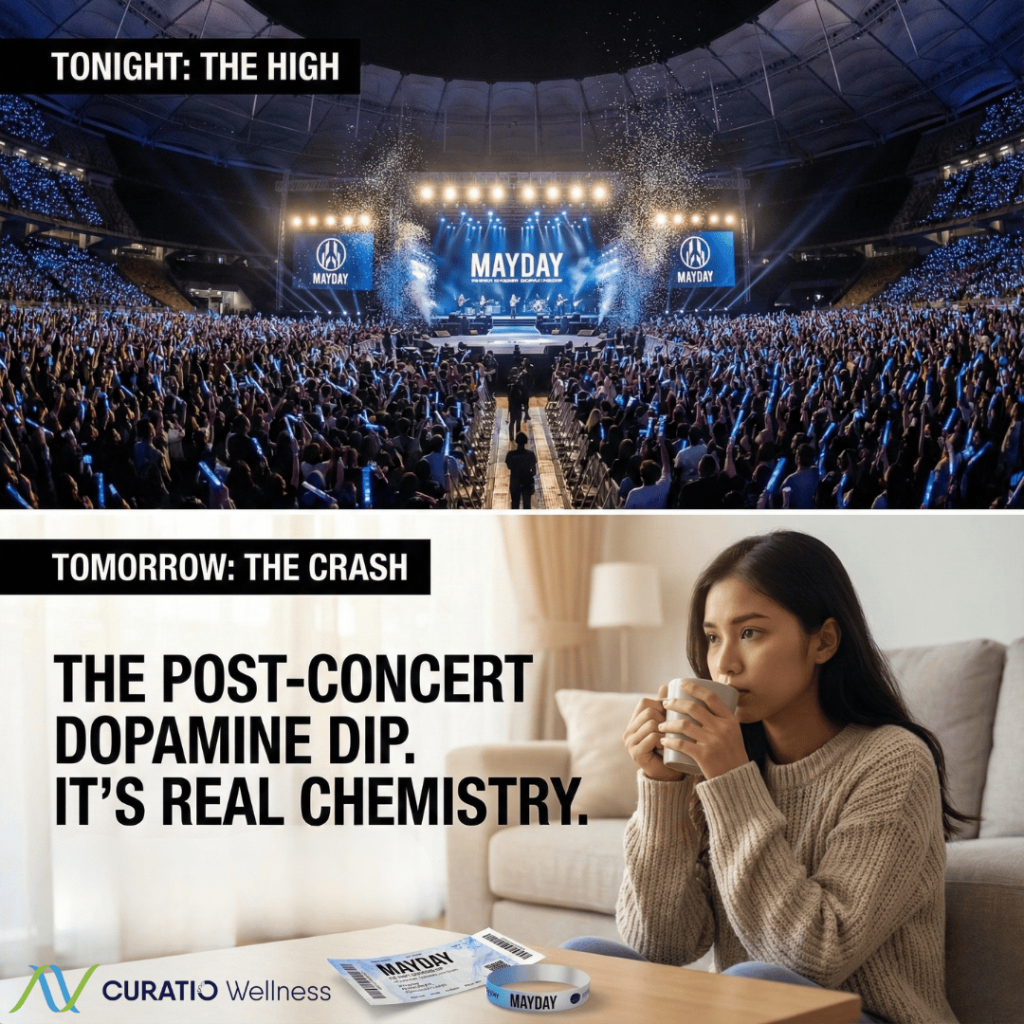
If you’re heading to the Mayday concert tonight, you’ll likely feel the surge, the lights, the crowd energy, and the music you’ve waited months to hear. Many people, however, wake up the next morning feeling unusually flat or low.
That experience is real, and it has a biological explanation. Live events flood the brain with dopamine and serotonin, chemicals linked to motivation, pleasure, and emotional connection. After hours of intense stimulation, the nervous system naturally rebalances by lowering those levels.
This temporary drop, sometimes called a post-concert dopamine dip, isn’t harmful. It can simply feel like an emotional “crash” as the brain transitions from high-intensity excitement back to its everyday rhythm.
Gentle movement, hydration, sunlight, and predictable routines help support that transition.
What you’re feeling isn’t overreacting. It’s chemistry settling down.
For science-led insights that explain how the body and mind respond to everyday experiences, you can follow Curatio Wellness.
#CuratioWellness #MaydayKL #ConcertHealth #DopamineScience #MalaysiaWellness #EmotionalHealth
/* widget: Post List */ #uc_post_list_elementor_0c306bc{ display:grid; } #uc_post_list_elementor_0c306bc .uc_post_list_image div{ background-size:cover; background-position:center; } .uc_post_list .uc_post_list_box{ position: relative; overflow: hidden; display: flex; } #uc_post_list_elementor_0c306bc .uc_post_list_image{ flex-grow:0; flex-shrink:0; overflow: hidden; } #uc_post_list_elementor_0c306bc .uc_post_list_image img{ width:100%; height:100%; display:block; transition:0.3s; position: relative; z-index: 1; } .uc_post_list_title a{ position: relative; z-index: 1; color: #333333; display: block; } .uc_post_list_date{ font-size: 12px; } #uc_post_list_elementor_0c306bc .uc_post_list_content{ display:flex; flex-direction:column; flex:1; } #uc_post_list_elementor_0c306bc .uc_more_btn{ text-align:center; text-decoration:none; transition:0.3s; position: relative; z-index: 1; } #uc_post_list_elementor_0c306bc .button-on-side{ display:flex; align-items:center; } #uc_post_list_elementor_0c306bc .ue-grid-item-category{ display: flex; align-items: center; } .ue-grid-item-category a{ display:inline-block; font-size:10px; text-transform:uppercase; white-space: nowrap; } #uc_post_list_elementor_0c306bc .ue-meta-data{ display:flex; flex-wrap: wrap; line-height:1em; } #uc_post_list_elementor_0c306bc .ue-grid-item-meta-data{ display:inline-flex; align-items:center; } .ue-grid-item-meta-data{ font-size:12px; } #uc_post_list_elementor_0c306bc .ue-grid-item-meta-data-icon{ line-height:1em; } #uc_post_list_elementor_0c306bc .ue-grid-item-meta-data-icon svg{ width:1em; height:1em; } #uc_post_list_elementor_0c306bc .ue-debug-meta{ padding:10px; border:1px solid red; position:relative; line-height:1.5em; font-size:11px; width:100%; } .uc-remote-parent .uc_post_list_box{ cursor:pointer; } #uc_post_list_elementor_0c306bc .ue-post-link-overlay{ display:block; position:absolute; top:0; bottom:0; right:0; left:0; }
Diabetes & Metabolic Health
Reversing Pre-Diabetes & Lifestyle Strategies
Sleep, Stress & Mental Wellness
Stress, Anxiety & Burnout Management
Menopause & Metabolism: What Changes, What Helps

Blood Sugar Control & Insulin Resistance
Diabetes & Metabolic Health
Reversing Pre-Diabetes & Lifestyle Strategies
Diabetes Remission Programme: A Smarter Alternative to Lifelong Medication

Mind-Body Wellness
Weight, Belly Fat & Metabolic Syndrome
When Healing Means Changing How You Listen to Your Body

Genetics & Personalised Health
Health Science & Research
Reversing Pre-Diabetes & Lifestyle Strategies
Beyond Routine Blood Tests: What New Science Reveals About You

Diabetes & Metabolic Health
Nutrition & Diet
Product & Service Spotlights
Diabetes Remission in Malaysia: Can Type 2 Diabetes Be Reversed Naturally?

Diabetes & Metabolic Health
Nutrition & Diet
One Kitchen, Many Needs: How Families Can Eat Healthier Together
No posts found