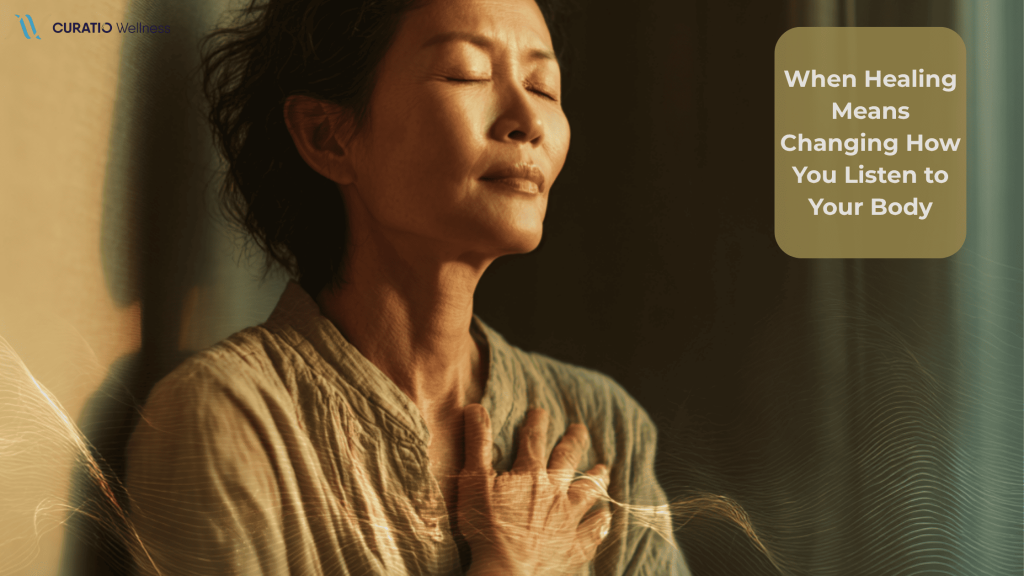
You don’t need to be unwell to feel disconnected from your health. For many of us, “listening to your body” sounds like vague wellness advice, yet it might be the most powerful form of early medicine we have.
In a world where smartwatches tell us when to breathe and apps remind us when to drink water, we’ve outsourced awareness. We measure sleep but forget to rest. We count steps but don’t notice how our legs feel. The body keeps sending signals—fatigue, tension, restlessness—but somewhere between busyness and self-criticism, we stop listening.
Healing, in its truest form, begins when we start to hear those signals again.
1. Your Body Speaks in Patterns, Not Words
The body doesn’t send alerts in plain language—it speaks in patterns. A tight chest after meetings, bloating after rushed meals, or persistent morning headaches aren’t random events; they’re feedback loops.
For people over 40, these patterns often reveal the early stages of imbalance:
Chronic fatigue points to disrupted sleep cycles and cortisol imbalance.
Digestive issues often reflect irregular meal timings or gut microbiome stress.
Aches and stiffness may signal inflammation, dehydration, or sedentary habits.
In Malaysian culture, it’s common to dismiss these cues as “age catching up.” But the truth is, your body isn’t breaking—it’s communicating. The problem begins when we silence it with quick fixes instead of curiosity.
Listening doesn’t mean panicking. It means observing without judgment, tracking how your body responds to food, rest, and emotions before symptoms turn into conditions.
2. Why Modern Life Makes It Hard to Listen
Our biology hasn’t evolved as fast as our environment. The human nervous system was built for nature, rhythm, and recovery—not blue light, deadlines, and 24/7 alerts.
When the brain stays in a constant “on” mode, stress hormones like cortisol stay elevated. Over time, that dulls your ability to sense what your body needs. You stop noticing early hunger cues, emotional fatigue, or shallow breathing.
Many people describe this as “numbness”—not emotional, but physical. You move from task to task, but rest never feels restorative. The body whispers for pause; the mind says, “just one more thing.”
Healing requires reintroducing slowness into your day—time without stimulation, time without performance. That’s when awareness returns.
Try this small shift: turn a daily task into a sensory experience. Notice the warmth of your morning shower, the first sip of water, the stretch in your spine when you stand. These tiny pauses rewire the nervous system to register calm, safety, and gratitude—the true start of physical repair.
3. The Science Behind “Body Awareness”
Far from being abstract, body awareness (interoception) is a measurable neurological skill. It’s how your brain perceives internal states—heartbeat, breathing, hunger, fatigue, and tension.
Research from neuroscience and functional medicine shows that people with higher interoceptive awareness often have:
Better emotional regulation and lower anxiety.
Improved immune response.
More stable blood pressure and heart rate variability.
Healthier weight maintenance due to early satiety recognition.
In simple terms, the better you listen, the better your body responds. However, stress, trauma, or chronic overwork can dull this internal sensitivity. You might only notice discomfort once it’s severe. That’s why many midlife conditions—hypertension, prediabetes, burnout—develop silently for years before being diagnosed.
Learning to reconnect doesn’t require medical training. It requires consistency—asking your body what it needs, not what it should do.
4. From Fixing to Partnering: A New Approach to Healing
Traditional healthcare often treats the body like a machine: identify the problem, apply the solution. But holistic wellness, as practised by Curatio Wellness Malaysia, encourages partnership. The body isn’t a problem to be fixed; it’s a system to be understood.
Healing is rarely linear. Some days you’ll feel progress; others, resistance. That doesn’t mean you’re failing—it means your body is recalibrating.
Curiosity instead of control: “What’s this feeling telling me?”
Support instead of punishment: Gentle movement over forced exercise.
Sustainability over speed: Progress that fits your rhythm, not someone else’s.
When patients approach health this way, outcomes often shift naturally—not because of miracles, but because stress and self-blame finally step aside, letting biology do its work.
5. Practical Ways to Reconnect With Your Body
You can start small—no equipment, no new apps, just awareness.
Morning check-in: Before checking your phone, take 60 seconds to scan your body. Where is tension? Where is ease?
Post-meal reflection: Notice energy or heaviness after eating. Patterns here often reveal food sensitivities or blood sugar swings.
Breath awareness: Three slow breaths before responding to an email or starting a meeting. It lowers heart rate and signals calm to your nervous system.
Gentle movement: Even light stretching or walking triggers dopamine and lymphatic flow—your body’s natural detox.
Night audit: Ask, “What helped me feel calm today?” That question builds memory pathways for rest.
Healing isn’t a supplement—it’s a skill built through daily noticing.
6. Redefining Success in Wellness
We often define success in health by what we can measure—lower cholesterol, smaller waistlines, cleaner reports. But true wellness includes what we can feel: peace, clarity, vitality, and connection.
Imagine wellness as a circle—nutrition, movement, sleep, emotional regulation, and meaning. Each feeds the other. When one improves, the rest follow.
Curatio’s philosophy of root-cause care isn’t about chasing perfection—it’s about restoring this circle. By listening, adjusting, and living with intention, we create conditions where healing can naturally unfold.
You don’t need to “do more.” You need to listen better.
7. The Quiet Science of Self-Trust
Every time you honour your body’s message—resting when tired, hydrating when thirsty, breathing when tense—you rebuild biological trust. Your body learns that you’re paying attention again, and in response, it softens. Hormones stabilise, inflammation lowers, and healing accelerates.
That’s why wellness isn’t about self-control—it’s about self-connection. The body already knows how to recover; it just needs you to stop overriding it.
Listening is the new discipline.
Final Thought
Healing begins the moment you stop asking, “What’s wrong with me?” and start asking, “What is my body trying to say?”
Your body isn’t an obstacle to manage—it’s your oldest companion, always speaking, always trying to help you return home.
For educational awareness only. Please consult a licensed clinician for personalised advice.
#CuratioWellness #MalaysiaWellness #FunctionalMedicine #HealthyAging #MindBodyConnection #MidlifeHealth #PreventiveCare #HolisticHealing #SelfAwareness #StressHealth #HormoneBalance #WellnessJourney