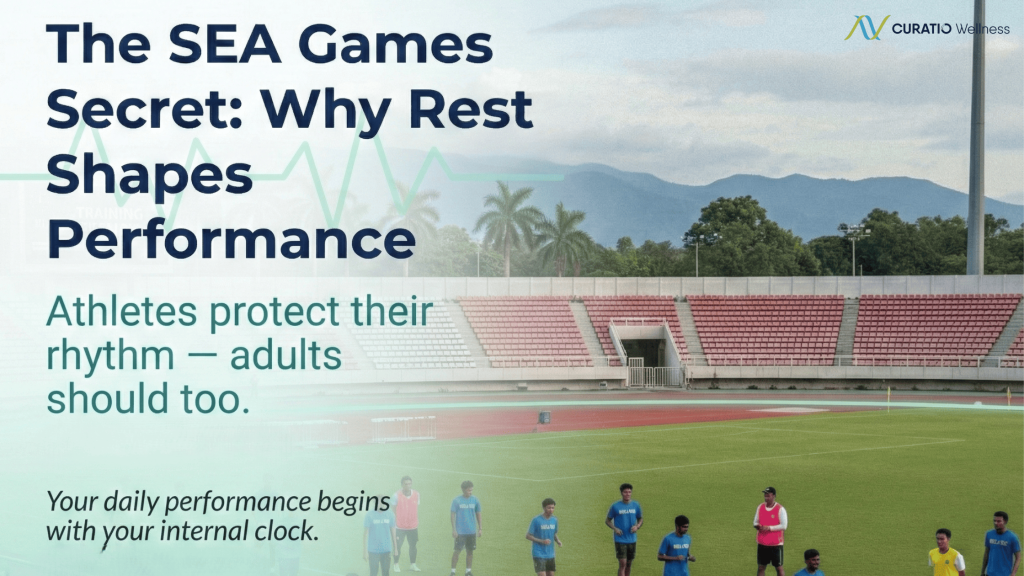
When Malaysians learned that the 2025 SEA Games contingent would travel six hours by land to Songkhla instead of taking a short flight, the decision seemed unusual. Why pick the longer route?
From a biological and public-health perspective, the answer is surprisingly relevant, not just for elite athletes, but for everyday Malaysians who feel tired even after weekends, holidays, or “good sleep.”
The land journey protects something far more important than convenience:
the body’s internal rhythm, the timing system that controls energy, inflammation, metabolism, and recovery.
And this same rhythm explains why so many adults feel chronically drained, even when life is not “that busy.”
This blog breaks down the science behind the SEA Games strategy and shows how the same principles apply to your energy, sleep, and long-term health.
1. What Athletes Know That Most Adults Forget: Rest Is Biological, Not Passive
Elite athletes treat rest like training.
Their performance depends on how well their internal clocks stay aligned. When rhythms are stable:
-cortisol rises naturally in the morning
-melatonin increases at night
-muscles recover in deep sleep
-inflammation stays controlled
-focus, mood, and metabolic health improve
Air travel disrupts this alignment because airplanes expose the body to environmental stressors:
• Lower oxygen levels (hypobaric hypoxia)
This mild oxygen drop triggers a stress response that can drain energy.
• Extremely low humidity
Leads to dehydration and thicker blood, making muscle perfusion harder.
• Artificial lighting
Confuses circadian timing.
• Fragmented rest and physical tension
Prevents deep recovery.
A stable land journey avoids these stressors and preserves the athletes’ biological timing.
Why This Matters to Malaysians:
You may not be preparing for competition, but your body still “performs” every day, at work, at home, and under stress.
If your internal rhythms are disrupted, you feel the same fatigue athletes try to avoid.
2. Why So Many Malaysians Feel Tired Even After Rest: The Public-Health Concept of Social Jetlag
Athletes avoid jet lag.
Adults unknowingly create a version of it every week.
Public-health researchers call this Social Jetlag, when your biological clock and your actual lifestyle run on different timings.
Common Malaysian patterns that create daily circadian disruption:
-sleeping late but waking early for work
-eating dinner at 9–10 PM
-catching up on sleep only on weekends
-relying on caffeine to feel “awake”
-heavy screen use at night
-long hours of sitting
-inconsistent meal timing
This misalignment affects:
-blood sugar stability
-mood and stress levels
-digestive rhythm
-hunger cues
-metabolic health
-morning alertness
Why It Feels So Personal:
You may think you’re “just aging”,
but your timing is misaligned, not your ability.
3. The Hidden Driver of Morning Fatigue: The Cortisol Awakening Response (CAR)
One of the clearest indicators of circadian misalignment is how you feel in the first hour after waking.
In a healthy rhythm:
Cortisol should rise naturally by ~50% within 30–45 minutes of waking.
This is the “biological ignition.”
But when stress, late nights, or irregular routines disrupt this response, you may notice:
-waking up heavy or groggy
-needing caffeine immediately
-mid-day crashes
-poor focus in the morning
-difficulty falling asleep at night (“tired but wired”)
This is not just “bad sleep.”
It’s your timing hormones failing to fire on time, a key public-health issue affecting working adults.
4. When Rest Doesn’t Work: The Science of Inflammation-Driven Fatigue
If you’ve ever slept more but felt no better, the explanation is often immunological.
Low-grade inflammation from:
-stress
-processed foods
-visceral fat
-irregular sleep
-sedentary routines
can trigger what scientists call Sickness Behavior, a built-in biological response that causes:
-low energy
-loss of motivation
-slower mental clarity
-physical heaviness
-social withdrawal
This mechanism evolved to protect the body during infection.
Today, it is often triggered by lifestyle inflammation, not illness.
Why This Matters:
If fatigue is caused by inflammation, sleep alone will not fix it.
Your biology needs rhythm, not just rest.
5. What Athletes Do and What Adults Can Learn
The SEA Games travel approach mirrors the framework used in sports science:
protect the internal environment first.
Here’s how these lessons translate to everyday Malaysian life:
A. Stabilise Your Light & Sleep Timing
Athletes avoid circadian disruption.
Adults can do the same with small habits:
-aim to sleep before 11 PM
-keep a consistent wake-up time
-reduce bright screens at night
-spend time outdoors during daylight
Light is the strongest reset signal for your biological clock.
B. Reduce Inflammation Through Daily Choices
Small dietary shifts can lower low-grade inflammation:
-limit refined carbohydrates and fried foods
-prioritise whole foods and fibre
-hydrate regularly
-add omega-3-rich foods (e.g., fish, nuts, seeds)
Not as a diet, as a public-health rhythm correction.
C. Support Metabolic Rhythm (Meal Timing Matters)
Your metabolism also runs on a clock.
Helpful habits:
-avoid heavy meals late at night
-space meals consistently
-include movement after eating (even 5 minutes helps)
These cues keep your energy stable throughout the day.
D. Pay Attention to Your Body’s Signals
Athletes track physiology closely.
Adults often push through:
-persistent fatigue
-irritability
-poor recovery
-disrupted sleep
-afternoon crashes
-brain fog
These are not personality traits,
they are signals your biological rhythm needs support.
6. Why Rest Is Now a Public Health Priority
Globally, researchers consider poor sleep timing, disrupted circadian rhythm, and chronic fatigue as emerging public-health challenges. They are linked to:
-rising metabolic conditions
-stress-related symptoms
-emotional burnout
-decreased productivity
-slower recovery
-lower overall wellbeing
When rest quality declines, health outcomes shift at a population level.
And this is why the SEA Games strategy matters for you:
It highlights the importance of protecting the body’s internal environment, something every adult benefits from, not just athletes.
7. The Bigger Lesson: Rest Is Not a Break, It Is a Biological Strategy
For athletes, rest determines performance.
For adults, it determines:
-daily energy
-mood stability
-inflammation
-metabolic health
-healthy aging
Your body isn’t asking for more exhaustion.
It’s asking for alignment.
When rhythms are stable, the body rebuilds, not just recovers.
The Takeaway
The SEA Games land-travel strategy is more than a logistics decision,
it is a reminder that performance is biological, whether on a sports field or in daily life.
If you feel persistently tired, unrefreshed after sleep, or inconsistent in your energy, the issue may not be effort, but internal misalignment.
Supporting your rhythms is not elite performance science.
Many adults experience misalignment without realising it. If you’re exploring these signals in your own life, Curatio Wellness can help you interpret your patterns safely and clearly.
It is everyday health science.
#CuratioWellness #SEAGames2025 #MalaysiaHealth #PublicHealth #RootCauseCare #MetabolicWellness #HealthyAging