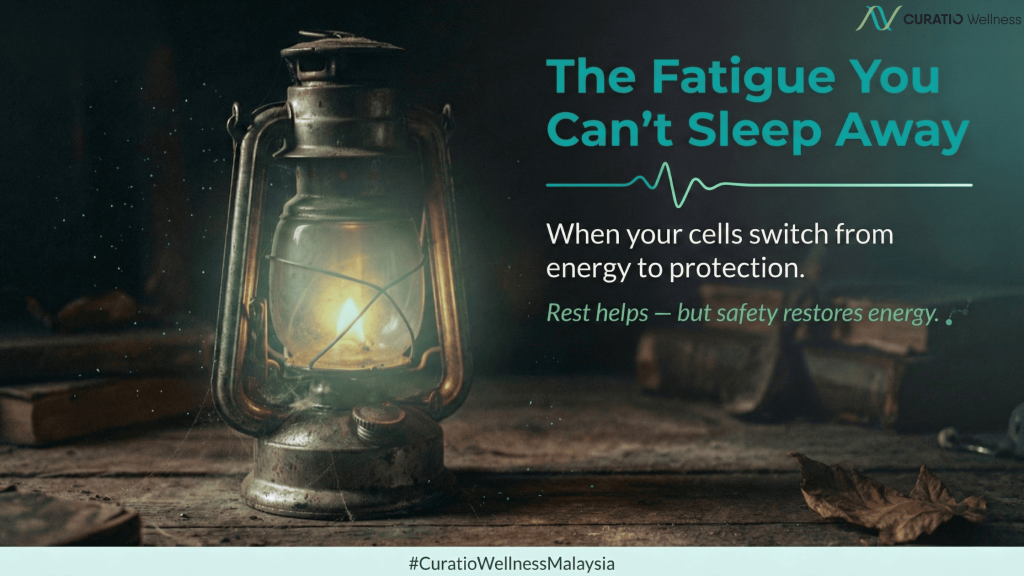
Why This Kind of Fatigue Feels Different
There is tiredness that goes away with a good night’s sleep, and then there is the heavy, persistent exhaustion that lingers even when you rest. Many Malaysians describe this as a “hollow tiredness”, a deep internal drain that feels far beyond being overworked.
This blog explores why that happens through a scientific lens that is gentle, non-alarming, and emotionally validating. You are not imagining your symptoms. And you are not weak.
What you may be experiencing is a shift inside your cells known as the Cell Danger Response (CDR), a protective state that changes how your body generates energy.
This is not diagnosis or treatment. The goal here is understanding, because understanding reduces fear, and reduced fear improves clarity.
Part 1: The Hidden Layer of Fatigue — Your Cells
Most people think exhaustion comes only from sleep loss, workload, or stress. But fatigue often begins much deeper, inside the mitochondria, the structures responsible for producing cellular energy.
Under normal conditions, mitochondria produce ATP, the fuel that supports movement, focus, digestion, hormone regulation, and immune activity.
When the body detects physical or emotional threat, including infection, chronic inflammation, burnout, prolonged stress, or unresolved trauma, mitochondria may temporarily shift roles. Instead of prioritising energy production, they prioritise protection.
This shift is known as the Cell Danger Response.
It is not a disease. It is not a defect. It is an evolved survival mechanism. The biology is protective, even if the lived experience feels overwhelming.
Part 2: What Exactly Is the Cell Danger Response (CDR)?
CDR describes a well-documented cellular state where mitochondria move from “production mode” into “defence mode”.
When the body senses danger, physical or emotional, cells behave like a town dimming its lights during a storm to protect the power grid.
During CDR:
Mitochondria reduce ATP output
Cells release danger signalling molecules
Metabolism slows
Muscles feel heavier
Brain function becomes foggy
Recovery feels delayed
Emotionally, many people describe it as trying to move through mud. This is not laziness. It is biology responding to overload.
Part 3: Why Sleep Doesn’t Fix This Fatigue
When mitochondria remain in protection mode, the body deprioritises high-energy functions such as cognitive clarity, mood regulation, digestion, hormone balance, and physical stamina.
Even with adequate sleep duration, the body cannot fully restore energy until it feels internally safe enough for cells to shift back into production.
This explains why people may wake up tired despite sleeping well. You slept, but your cells stayed guarded.
This disconnect often leads to self-blame. Understanding CDR replaces that blame with clarity.
Part 4: What Triggers Cellular Exhaustion?
CDR can be triggered gradually or suddenly. Common contributors include chronic inflammation, post-viral recovery, long-term emotional stress, fragmented sleep, nutrient imbalance, and environmental load.
None of these mean something is wrong with you. They mean your cells are working harder than usual behind the scenes.
Part 5: The Emotional Layer — Why This Fatigue Feels Personal
Because many people link identity to productivity, persistent fatigue often brings guilt, frustration, shame, and fear of being misunderstood.
Mitochondrial fatigue is invisible. Being told “you look fine” can deepen emotional exhaustion.
Your experience is valid. Your symptoms have a biological basis. You are not imagining it.
Part 6: How Cellular Exhaustion Affects Daily Life
People in CDR often notice fluctuating energy, brain fog, low exercise tolerance, mood shifts, and digestive changes. These patterns reflect energy conservation, not weakness.
Part 7: How the Nervous System and Mitochondria Communicate
When the nervous system senses safety, mitochondria increase energy production. When it senses threat, mitochondria conserve energy.
This is why emotional safety, predictable routines, supportive relationships, and manageable stress loads matter biologically, not just psychologically.
Part 8: What Helps the Body Feel Safe Again?
Recovery is supported by predictable rhythms: gentle movement, consistent sleep timing, reduced overstimulation, morning light exposure, regular meals, hydration, calming practices, and supportive conversation.
These are not treatments. They are signals that gradually tell cells it is safe to return to energy production.
Final Reflection
You do not need to carry exhaustion in silence. When fatigue feels unexplainable, the explanation often lives deeper, inside cellular biology.
Understanding is not a cure, but it is the first step toward easing the emotional weight of chronic fatigue.
#CuratioWellness #CellularExhaustion #MitochondriaHealth #ChronicFatigueScience #CellDangerResponse #MalaysiaWellness #StressBiology #RootCauseCare